Bike Chain Length, Wear & Replacement Guide 2026
How-To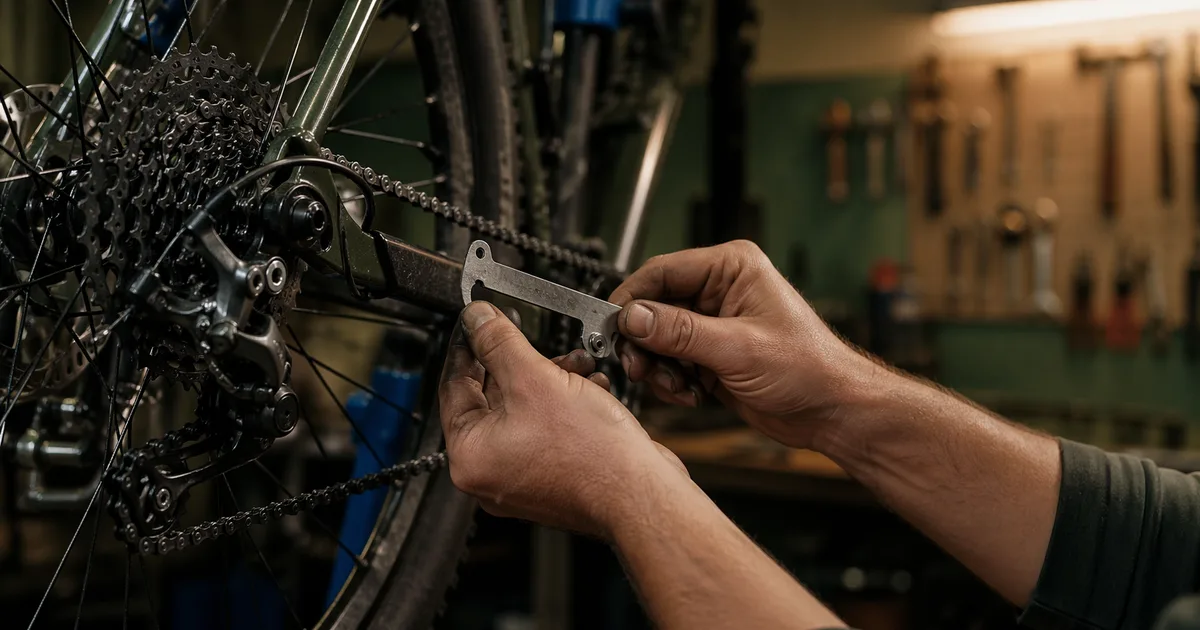
Your chain is the cheapest part of your drivetrain - and the one most likely to silently destroy the expensive parts around it. A worn chain chews through cassettes and chainrings, robs you of clean shifts, and eventually leaves you walking. The good news: with a tape measure, a $15 wear gauge, and ten minutes a month, you can make a chain last thousands of miles and keep the rest of your drivetrain alive for years. This guide walks you through sizing a new chain, checking wear, choosing a lube, and replacing the chain before it costs you a cassette.
Quick Answer
Size a new chain by wrapping it around the largest chainring and largest cog (without going through the derailleur), then add 2 links for the join. Replace the chain at 0.5% wear on 11-13 speed drivetrains and 0.75% on 8-10 speed. Most chains last 1,500-3,000 miles. Use our Chain Length Calculator to find the exact number of links for your bike.
Specialized Chain Tools
Start with the right numbers. These free calculators take the guesswork out of sizing and gearing decisions before you cut a single link.
Enter chainstay length, biggest chainring, and biggest cog to get an exact link count
See gain ratios across chainring and cassette combos before replacing parts
A clean drivetrain pairs nicely with proper pressure for the smoothest ride
Make sure the frame fits before fine-tuning drivetrain components
How a Bike Chain Works
A modern bicycle chain is a roller chain made of four repeating parts: outer plates, inner plates, pins, and rollers. Pins press through the outer plates and pivot inside bushings formed by the inner plates. A roller spins freely around each bushing, contacting the cog or chainring tooth. That rolling contact - rather than sliding - is what makes a bike chain so efficient.
Pitch and Speed
Every modern derailleur chain shares the same 1/2" (12.7 mm) pitch - the center-to-center distance between adjacent pins. What changes by drivetrain speed is the chain's outer width. As cassettes have grown from 8 cogs to 13, the chains have gotten narrower to fit between tighter cog spacing.
| Speed | Outer Width | Typical Use |
|---|---|---|
| 8 speed | 7.1 mm | Commuter, older MTB |
| 9 speed | 6.6 mm | Entry road and MTB |
| 10 speed | 6.0 mm | Older performance bikes |
| 11 speed | 5.5 mm | Modern road, gravel, MTB |
| 12 speed | 5.25 mm | Current road, MTB, e-bike |
| 13 speed | 4.9 mm | Campagnolo Ekar gravel |
Narrower chains are more sensitive to wear, contamination, and misalignment, which is why the modern 12-speed era has pushed riders to be more disciplined about cleaning and earlier replacement.
Measuring Chain Length
A new chain comes in a fixed length - usually 116 or 118 links - and almost always needs to be shortened. Cut it too short and the rear derailleur will tear off when you shift into the big-big combination. Cut it too long and the chain sags, slaps the chainstay, and shifts poorly in the small-small combination.
The Park Tool “Big-Big Plus Two” Method
The most reliable method, used by professional mechanics, bypasses the derailleur entirely:
- Shift to the largest chainring and largest cassette cog.
- Route the new chain over the largest chainring and around the largest cog, without threading it through the rear derailleur.
- Pull the two ends together until they meet at the bottom of the chain loop.
- Add two links (one inner plate pair plus one outer plate pair) to that length. This is your final chain length.
- Break the chain at that point and reinstall it through the rear derailleur using a quick link or replacement pin.
The Math: Sheldon Brown Formula
If you prefer a calculation, use this formula where C is chainstay length in inches, F is chainring teeth, and R is cassette teeth:
L = 2 × (C / 25.4) + (F + R) / 4 + 1
The result is the chain length in inches. Round up to the nearest even number and convert to links (1 inch = 2 half-links). For full-suspension bikes, measure chainstay length with the rear suspension fully extended - sag will shorten effective chainstay and require slightly more chain than the static measurement suggests.
Mechanic's Tip
Skip the formula and use our Chain Length Calculator. Enter your chainstay length, largest chainring, and largest cog, and you'll get the exact link count - including recommendations for clutch derailleurs and full-suspension travel.
Checking Chain Wear
“Chain stretch” is a misnomer. The plates don't actually stretch - the pins and bushings wear, allowing the chain to elongate. Once that elongation passes a critical threshold, the chain no longer matches the cog tooth spacing and starts to accelerate wear on the cassette and chainrings.
Wear Thresholds by Speed
| Drivetrain | Replace Soon | Replace Now |
|---|---|---|
| 11, 12, 13 speed | 0.5% | 0.75% |
| 9, 10 speed | 0.75% | 1.0% |
| 8 speed and singlespeed | 1.0% | 1.0%+ |
Tools for Measuring Wear
- Park Tool CC-3.2: A drop-in “go/no-go” gauge with 0.5% and 0.75% sides. Designed to read accurately on modern chains by referencing only the inner roller positions.
- Shimano TL-CN42: Shimano's pivoting gauge, also designed to ignore roller play. Marked at 0.5% and 0.75%, with a clear color-coded indicator.
- Pedro's Chain Checker Plus II: Direct-read gauge that displays exact wear percentage rather than just a threshold.
- Steel ruler: The classic method - measure from the center of one pin to the center of another exactly 12 inches away. A new chain reads 12.000". At 12.0625" (1/16") the chain is 0.5% worn; at 12.125" (1/8") it's 1.0% worn.
Watch Out
Many cheap drop-in chain checkers (the kind that come in a starter tool kit) measure both pin elongation and roller play, which makes a brand-new chain read as 0.25% “worn.” If your gauge tells you a fresh chain is already due, replace the gauge, not the chain.
When to Replace Your Chain
Replacing the chain at the right time is the single best way to extend the life of your cassette and chainrings. A cassette that should last 10,000 miles can be ruined in 3,000 if you ride a worn chain on it.
Mileage Estimates
- Road, dry conditions: 2,000-3,000 miles
- Road, mixed conditions: 1,500-2,500 miles
- Gravel and cyclocross: 1,000-2,000 miles
- Mountain bike, dry: 1,000-1,500 miles
- Mountain bike, wet/muddy: 500-1,000 miles
- E-bike (mid-drive): 800-1,500 miles due to higher torque
These are starting points, not laws. A meticulous wax user can double them; a rider who lubes a dirty chain with the wrong oil can halve them. Trust the wear gauge over the odometer.
Symptoms of a Worn Chain
- Skipping under load: The chain jumps over cog teeth when you stand to climb - especially in the mid-cassette gears you use most.
- Slow, hesitant shifts: Especially noticeable downshifting to easier gears.
- Cassette tooth wear: Hooked or shark-fin shaped teeth, particularly on the most-used cogs.
- Chain sits high on the cog: A telltale sign that chain pitch no longer matches cog spacing.
- Visible side-to-side play: Lift the chain off the chainring at the 3 o'clock position. If it lifts more than a roller's width, the chainring or chain is past its prime.
Don't Wait Too Long
If you replace a chain past 1.0% wear, the new chain will skip on the worn cassette, and you'll need to replace both. A $30 chain installed on time saves a $150 cassette and potentially a $200 chainring.
Chain Cleaning & Lubrication
The two enemies of a chain are grit and dryness. Grit acts as grinding paste between pin and bushing; dryness causes metal-on-metal contact. Lube's job is to displace water, fill clearances, and keep contaminants from getting in.
Lube Types Compared
| Lube | Best For | Interval | Trade-Off |
|---|---|---|---|
| Dry | Dry, dusty roads & trails | Every 100-150 mi | Washes off in rain |
| Wet | Rain, mud, winter | Every 150-200 mi | Attracts grit fast |
| Wax (drip) | Mixed conditions, low mess | Every 100-200 mi | Needs clean chain to start |
| Hot wax (immersion) | Maximum efficiency & longevity | Every 200-400 mi | Setup time, requires crockpot |
Cleaning Sequence
- Quick wipe (every ride): Run the chain backwards through a clean rag while shifting to the smallest cog. Removes loose grit before it embeds.
- Clean when dirty: Follow the chain-cleaning sequence and the chain and cleaner makers' instructions. Let the chain dry before applying the chosen lubricant.
- Re-lube on a dry chain: Apply one drop of lube to each roller, run the drivetrain backwards 10-20 turns to let it penetrate, then wipe off all surface lube. The lube you can see is just dirt-magnet - the lube inside the rollers is what works.
Pro Tip
A new chain ships with sticky factory grease that attracts grime. Many wax users degrease a new chain before its first ride and start fresh with their preferred lube. For wet or dry lubes, the factory coating is fine to leave on.
Installation & Master Links
Once your chain is sized, you have two ways to join the ends: a master link (also called a quick link) or a press-fit replacement pin.
Master Links (Quick Links)
SRAM PowerLock, Shimano Quick-Link, KMC MissingLink, and Connex's reusable links all provide tool-free joining. They're the standard for modern chains because they let you remove the chain for cleaning. Match the master link to your chain's speed - an 11-speed link will not seat correctly on a 12-speed chain. Most manufacturers rate single-use links (SRAM, Shimano) for one installation; reusable links (KMC, Connex) can be opened and closed many times.
Press-Fit Pins
Shimano traditionally uses replacement pins instead of quick links. These are pressed in with a chain tool, then the protruding guide end is snapped off. Done correctly, a properly installed pin is extremely secure. Done incorrectly, it's the most common cause of chain failure on rides.
Installation Checks
- The joined link should flex as freely as every other link. A stiff link causes a clicking skip every revolution - flex it laterally between your fingers to free it.
- For SRAM PowerLock: position the link at the top of the chain (between cassette and chainstay), pedal forward firmly to seat it, then pull on the chain to confirm it's locked.
- Always carry a spare quick link of the correct speed in your ride-repair kit. A snapped chain is a 5-minute fix trailside if you have one, and a long walk if you don't.
Drivetrain Compatibility
The single most important compatibility rule: chain speed must match cassette speed. An 11-speed chain on a 12-speed cassette will shift sloppily and fall between cogs; a 12-speed chain on an 11-speed cassette will rub adjacent cogs and shift poorly.
Cross-Brand Mixing
Within the same speed, most chains work across brands - with caveats:
- Shimano and KMC: Highly interchangeable across all speeds. KMC actually manufactures many OE chains for major brands.
- SRAM Flat-Top (Red/Force/Rival AXS): Uses a unique chain profile with flat-topped outer plates. Only SRAM Flat-Top chains work on these cassettes.
- Campagnolo 12-speed: Has its own chain (C12); not compatible with SRAM/Shimano 12-speed.
- Campagnolo Ekar 13-speed: Uses a purpose-built C13 chain with no cross-brand alternative.
When in doubt, match the chain to the cassette brand. If you're considering a gearing change at the same time as a chain swap, plug your numbers into the Gear Ratio Calculator first to make sure the new combination gives you the gain ratios you actually want.
Common Chain Mistakes
- Lubing a dirty chain: Adding fresh lube on top of gritty old lube creates grinding paste. Always clean first.
- Using too much lube: Excess surface lube collects dirt within minutes. One drop per roller, then wipe.
- Riding past 0.75% wear: The cassette and chainrings start wearing in sympathy with the chain. Replace early and they last 3-4 chains.
- Mixing chain and cassette speeds: See the compatibility section - a mismatch is the most common cause of mystery shifting problems.
- Cutting the chain too short: If you can't shift into big-big without binding the rear derailleur, you're one missed shift away from a destroyed derailleur, hanger, or frame.
- Reusing a single-use master link: SRAM and Shimano quick links are designed to deform on installation. Reopening them weakens the join. Use a fresh one every time.
- Ignoring a noisy drivetrain: A chain that squeaks is metal-on-metal - every minute of squeak is wear that can't be undone.
Recommended Chain Tools
Everything you need to measure, lube, and replace your chain.
Park Tool
Park Tool CC-3.2 Bicycle Chain Checker
Go/no-go chain-wear gauge for 5-12 speed chains that reads 0.5% and 0.75% elongation. The standard drivetrain-maintenance tool; use alongside our chain length and gear ratio calculators.
Park Tool
Park Tool SR-12.2 Sprocket Remover / Chain Whip
Shop-quality chain whip for holding the cassette when removing lockrings - needed whenever you swap cassettes to change gear ratios.
Crankbrothers
Crankbrothers M19 Multi-Tool
19-function bike multi-tool with hex, Torx, screwdriver, and chain breaker. The go-to ride-along tool for saddle height, seatpost, and on-the-road adjustments.
As an Amazon Associate we earn from qualifying purchases. Purchases made through these links help support our free calculators.
Frequently Asked Questions
Conclusion
Chain maintenance is the highest-leverage habit in bicycle ownership. A few minutes of cleaning and lubing each month, plus a 30-second wear check, prevents almost every expensive drivetrain failure. The chain is cheap; the cassette, chainrings, and derailleur are not. Replace the chain on schedule and the rest of your drivetrain will outlast it many times over.
Key Takeaways
- Size with big-big + 2: Wrap a new chain around the largest chainring and largest cog, then add two links. Use the Chain Length Calculator to verify.
- Measure wear monthly: A quality drop-in gauge (Park CC-3.2, Shimano TL-CN42) takes seconds and saves cassettes.
- Replace at 0.5% on 11+ speed and 0.75% on 8-10 speed. Past 1.0%, expect to replace the cassette too.
- Match chain speed to cassette speed: No mixing across drivetrain generations or brand-specific systems (SRAM Flat-Top, Campagnolo C12/C13).
- Clean before you lube: Fresh lube on a dirty chain accelerates wear. One drop per roller, then wipe off surface lube.
- Carry a spare quick link: Cheap insurance against a long walk home.
- Trust the gauge over the odometer: Conditions and lube choice can double or halve a chain's service life.
Ready to put it into practice? Start with our Chain Length Calculator to size a new chain correctly the first time, then explore the Gear Ratio Calculator if you're thinking about a cassette swap. If the wear gauge is at or beyond its replacement threshold, check when to replace the chain before fitting a new one.