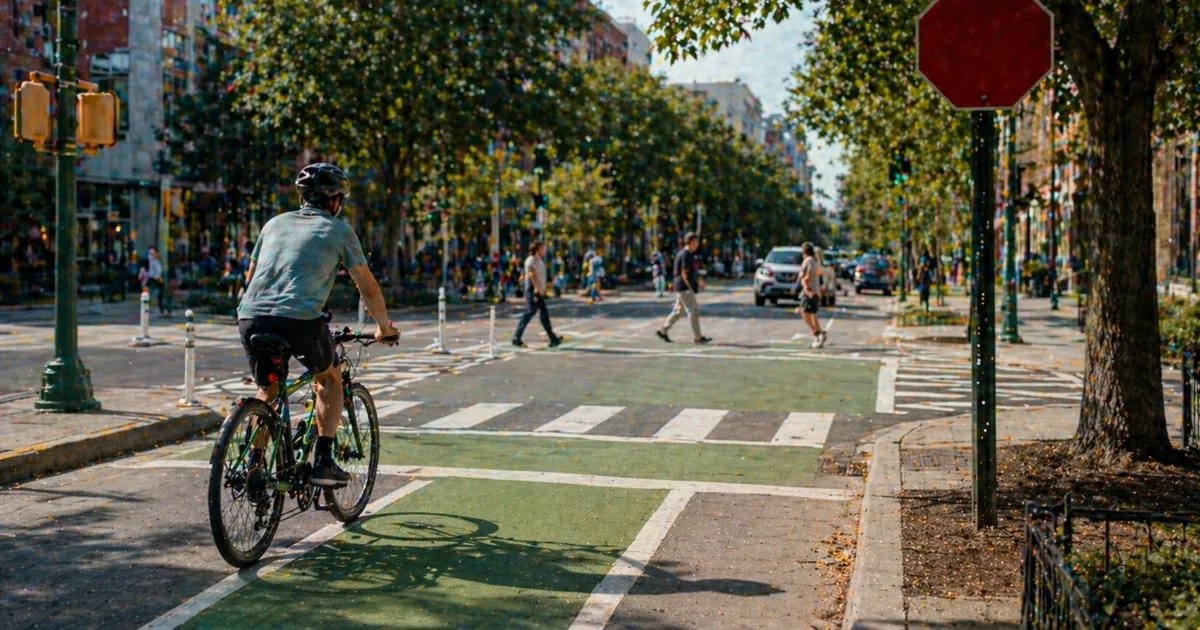
Quick answer
- Cyclists have the same rights and duties as drivers in every US state - the rule traces directly to the Uniform Vehicle Code 1 and is codified almost verbatim in state vehicle codes from California to Maine.
- Ten states have adopted some form of "safety stop" letting cyclists treat stop signs as yield signs: Idaho (1982), Delaware (2017, limited), Arkansas (2019), Oregon (2019), Washington (2020), Utah (2021), North Dakota (2021), Oklahoma (2021), Colorado (2022), and Minnesota (2023).
- Most states have a "dead-red" provision allowing a cyclist to proceed through a red light after a reasonable wait when the signal's vehicle detector fails to register the bike.
- *Every state requires riding with traffic, not against it* - wrong-way riding is one of the strongest crash-risk factors in the FHWA cyclist-safety data 3.
- The "as far right as practicable" rule has statutory exceptions everywhere - substandard-width lanes, hazards, preparing to turn left, riding on a one-way street, and faster-than-traffic speed all let you take the lane.
- Safe-passing distance is 3 feet in most states; 4 feet in Pennsylvania and South Dakota, and "change lanes when safe" in a growing number of others including North Carolina, Kentucky, and Iowa.
The "same rights, same duties" doctrine
Almost every modern US bicycle traffic law starts from a single sentence in the Uniform Vehicle Code (UVC) § 11-1202: "Every person riding a bicycle upon a roadway shall be granted all of the rights and shall be subject to all of the duties applicable to the driver of a vehicle by this chapter." 1 The UVC is a model code maintained by the National Committee on Uniform Traffic Laws and Ordinances; it has no legal force on its own, but it has been the template for state vehicle codes since the 1920s, and the rights-and-duties clause has been adopted, almost verbatim, by every US state.
California's Cal. Veh. Code § 21200 5, for example, says: "A person riding a bicycle … upon a highway has all the rights and is subject to all the provisions applicable to the driver of a vehicle by this division …" New York's N.Y. Veh. & Traf. Law § 1231 9 is essentially the same sentence. So is Florida's Fla. Stat. § 316.2065(1) 8 and Texas's Tex. Transp. Code § 551.101 10. The wording is so consistent that a transportation lawyer can recognise the pattern across all 50 states at a glance.
What that doctrine means in practice: a cyclist must obey traffic-control devices, signal turns, yield where a driver would yield, ride on the right, and pass on the left. A cyclist also receives every protection a driver receives - right of way at a green light, right of way through an intersection on a straightaway, the protected status of a vehicle in its lane. The cyclist-specific provisions discussed below are layered on top of this baseline; they modify it in narrow ways but never replace it.
Stop-sign rules and the Idaho Stop
The general rule everywhere is simple: a cyclist must come to a complete stop at every stop sign, just like a driver. The exception - and it is now a meaningful one - is the safety stop (also called the Idaho Stop, the Delaware Yield, or the bicycle-yield rule, depending on the jurisdiction). In a safety-stop state, a cyclist approaching a stop sign may, after slowing and yielding the right of way to any pedestrians or vehicles already in the intersection or close enough to constitute an immediate hazard, proceed through the intersection without coming to a full foot-down stop.
Idaho pioneered the rule in 1982 under Idaho Code § 49-720 11, and it sat alone for 35 years before other states followed. Since 2017, the policy has spread quickly:
- Idaho (1982) - Idaho Code § 49-720. The original. Cyclists may treat stop signs as yields and red lights as stop signs.
- Delaware (2017) - 21 Del. C. § 4196A 12. Limited form: applies only at intersections of two-lane roads (the "Delaware Yield").
- Arkansas (2019) - Ark. Code § 27-49-111 13. Full Idaho-style stop-as-yield and red-as-stop.
- Oregon (2019) - ORS 814.414 14. Stop signs and flashing reds can be treated as yields by cyclists.
- Washington (2020) - RCW 46.61.190(3) 15. Cyclists may treat stop signs as yields after slowing.
- Utah (2021) - Utah Code § 41-6a-1102 16. Stop signs as yields for bicycles.
- North Dakota (2021) - N.D. Cent. Code § 39-10.1-08. Idaho-style safety stop.
- Oklahoma (2021) - Okla. Stat. tit. 47, § 11-1208 17. Stop signs as yields.
- Colorado (2022) - C.R.S. § 42-4-1412.5 18. Statewide "Bicycle and Low-Speed Conveyance Safety Stop" - also allows e-bikes and electric scooters to use the rule.
- Minnesota (2023) - Minn. Stat. § 169.222 subd. 4a 20. Most recent adopter.
The legal nuance is critical. A safety-stop statute does not give a cyclist the right of way over conflicting traffic - it simply replaces the duty to come to a complete stop with a duty to slow and yield. If a car or pedestrian is already in or approaching the intersection, the cyclist must still yield. Treating the rule as "I never have to stop" is a misread of the statute and a fast way to a citation or a crash. The Colorado Department of Transportation explicitly notes in its Safety Stop guidance 19 that the rule is about removing an awkward, unstable foot-down stop where it is not needed - not about giving cyclists priority.
Local pre-emption matters. In Colorado and Oregon, the state safety stop applies only where a city has not opted out (Colorado) or where it does not conflict with a local ordinance (some Oregon municipalities still require a full stop in specified zones). Always check the municipal code of the city you are riding in if you are operating right at the limit of the rule.
Outside the ten safety-stop states, the rule is unambiguous: come to a full, foot-down or balanced-track-stand stop at every stop sign. Failure to do so is the single most common bicycle-citation issue in dense urban jurisdictions, and it is also the most legally indefensible. Ride defensively and stop.
Red-light rules and dead-red provisions
The general rule for red lights is also simple: a cyclist must stop and wait, just like a driver. There is one important cyclist-specific carve-out, the dead-red provision (sometimes called the "affirmative defence to red-light running"). The problem the rule addresses is real: many traffic signals use inductive-loop sensors embedded in the pavement that detect the steel mass of a car. A bicycle's much smaller steel content often fails to trip the sensor, so a cyclist arriving alone at an intersection can wait through a full cycle without ever getting a green. The dead-red rule lets the cyclist, after a reasonable wait, treat the malfunctioning red as a stop sign - yield to cross traffic, then proceed.
Dead-red statutes have been adopted by a substantial majority of states, including (non-exhaustively) Arkansas, Idaho, Illinois (625 ILCS 5/11-306(c)(4)) [^il-625-5-11-306], Kansas, Minnesota, Missouri, Nevada, North Carolina (N.C.G.S. § 20-158(a)(3)) [^nc-20-158], Oklahoma, South Carolina, Tennessee, Virginia (Va. Code § 46.2-833 [^va-46-2-833]), and Wisconsin. The "reasonable wait" varies - Virginia and several others specify two minutes; many simply say a "reasonable amount of time" and leave it to the officer or court.
The four safety-stop states that go furthest - Idaho, Arkansas, North Dakota, and Oklahoma - also let cyclists treat every steady red as a stop sign, with no waiting period required (the rider must still come to a complete stop and yield to all conflicting traffic before proceeding). Most other states require an actual signal malfunction before the dead-red rule applies.
Right of way at intersections
Because cyclists are treated as drivers, the standard intersection rules of the road apply unchanged. At an uncontrolled intersection (no signs or signals), the vehicle on the right has the right of way when two arrive at the same time. At a four-way stop, the first to arrive goes first; ties go to the right. A cyclist signalling and waiting at a four-way stop is as much a part of the rotation as any car, and a driver who refuses to yield to a properly positioned cyclist is committing the same failure-to-yield violation they would commit against another car.
Turning vehicles must yield to through traffic - including a through-moving cyclist. This is the single most-cited rule in cyclist-vs-car crashes: a driver turning right or left across the cyclist's path is required to yield, and the failure to do so is the legal predicate for liability. NHTSA's bicycle-safety crash typology 2 consistently identifies the "right hook" (driver turning right across a cyclist proceeding straight) and the "left cross" (driver turning left across an oncoming cyclist) as the two highest-frequency intersection conflict patterns.
Crosswalks and pedestrians. When riding on the road, a cyclist must yield to pedestrians in a crosswalk to the same extent a driver must - this is uniform across state vehicle codes. When dismounting and walking the bike across a crosswalk, the cyclist becomes a pedestrian and gains pedestrian right-of-way protections. When riding through a crosswalk, the legal status varies by state: some treat the cyclist as a vehicle subject to vehicle rules at the intersection, others extend pedestrian protections, and a few (notably some Florida cities) require the cyclist to dismount.
Riding with traffic, not against it
Every US state requires bicycles to be ridden in the same direction as motor-vehicle traffic on a roadway. The wrong-way exception exists only on streets with a marked contraflow bike lane, on a properly designated bike route, or where the cyclist is operating as a pedestrian on the shoulder of a road that lacks a sidewalk. The classic statutory wording - "any person operating a bicycle upon a roadway shall ride … in the same direction as the flow of traffic" - appears in California's § 21650.1, Florida's § 316.2065(5)(a), and dozens of other state codes.
The reason the rule is universal is the safety data. The Federal Highway Administration's pedestrian and bicycle research center 3 has consistently identified wrong-way riding as one of the strongest single risk factors for cyclist-vs-driver crashes - drivers entering a roadway from a driveway or side street scan in the direction of expected vehicle traffic and do not see a bicycle approaching from the "wrong" direction until the conflict is already happening. Riding against traffic also doubles the closing speed of a head-on impact, which compounds injury severity. The legal duty and the safety reality point in the same direction.
Lane positioning and the "as far right as practicable" rule
Most state vehicle codes contain a version of the far-right rule - a cyclist riding slower than the normal speed of traffic must ride "as close as practicable to the right-hand curb or edge of the roadway." California's § 21202 6 is the canonical text and the model for many other states. The word "practicable" - not "possible" - is doing a lot of work in that sentence. It means the rider must consider safety, not be pushed into a hazard.
Statutory exceptions are written into the same statute and apply in nearly every state. A cyclist may take the lane - ride in the centre of the travel lane, or anywhere safe within it - when:
- Overtaking and passing another vehicle moving in the same direction.
- Preparing to make a left turn at an intersection or into a private road or driveway.
- Avoiding a hazard - debris, parked-car door zones, drain grates, surface defects, or any other condition that makes the right edge unsafe.
- Riding in a lane that is too narrow to share safely with a motor vehicle (the "substandard-width lane" exception). A standard travel lane in most US states is 10 to 12 feet wide; a lane under about 14 feet is generally too narrow for a car to pass a cyclist safely while staying within the lane.
- Riding on a one-way street with two or more marked lanes - many states allow the cyclist to ride as close to the left curb as practicable instead, which is often safer in dense urban grids.
- Approaching a place where right turns are authorised - the cyclist proceeding straight may move out of the right-turn-only lane and into the through lane.
The substandard-width-lane exception is the most important one for everyday urban riding and is the legal basis for the "take the lane" advice you will hear from instructors at any League of American Bicyclists Smart Cycling course. If the lane is not wide enough for a car to pass you with the legally required distance (more on that next) without crossing into the next lane, you are entitled to ride centrally and require the driver to change lanes. NACTO's Urban Bikeway Design Guide 4 formalises this by recommending lane widths of 14 feet or wider where cyclists are expected to share the lane with motor vehicles, precisely so that the far-right rule can operate without forcing close passes.
Safe-passing distances
Every state except a small handful now has a statutory minimum distance for a motor vehicle passing a bicycle. The dominant standard is three feet, but the trend is towards larger distances and "change lanes when safe" rules:
- Three feet - the most common standard, in force in most states with a numeric rule. California's Three Feet for Safety Act (Cal. Veh. Code § 21760) 7 is a representative example; effective January 1, 2024, California amended the law to also require a full lane change when a 3-foot pass is not possible.
- Four feet - Pennsylvania (75 Pa.C.S. § 3303(a)(3)) 24 and South Dakota set a 4-foot minimum. New York City Council has also debated a 4-foot rule for the city, though state law remains 3 feet.
- "Change lanes when safe" - North Carolina (N.C.G.S. § 20-149.1), Kentucky, Iowa, and a growing number of other states require a full lane change to pass a cyclist when the lane is too narrow to give the legal distance. This is the strongest statutory protection because it eliminates the line-of-sight ambiguity around "how close is three feet?"
- No statutory minimum - a small and shrinking group; even where no number applies, the general "safe distance" rule for overtaking still protects cyclists, and a sub-3-foot pass can support a careless-driving citation.
Practical reality: the safe-passing distance is enforced primarily after a crash. Day-to-day enforcement of close-pass rules is rare in most jurisdictions, although several US cities (notably Chattanooga, Houston, and Austin) and the UK have piloted plain-clothes officer-on-bike programs that issue close-pass citations in real time. The clear majority of close-pass investigations begin with cyclist video evidence - yet another reason a rear-facing camera is now standard kit for many urban commuters.
Vulnerable road user laws
A growing number of states have enacted Vulnerable Road User (VRU) statutes that elevate the penalties when a driver injures or kills a cyclist, pedestrian, road-construction worker, or other non-motorised user. The model legislation, originally drafted by the League of American Bicyclists, treats vulnerable users as a protected class - driver behaviour that would normally be a moving violation can become a misdemeanour, and serious injury or death can trigger licence-suspension, traffic-school, and community-service requirements that go beyond the standard penalty schedule.
Oregon was the first state to adopt a comprehensive VRU statute (ORS 811.135, the "careless driving" enhancement when a vulnerable user is injured) 25. Washington's RCW 46.61.526 (Negligent Driving - Second Degree, with VRU enhancement) 26 requires a 90-day licence suspension, a $250 to $5,000 fine, and a traffic-safety course where serious injury or death of a vulnerable user results from negligent driving. Delaware, Hawaii, Connecticut, Vermont, and several others have followed with their own variants. Some states limit the enhancement to careless or negligent driving; a few extend it to any moving violation that proximately causes serious injury.
*What VRU laws do not do:* they do not override the basic rules of right of way, they do not shift the legal duty to be visible and predictable away from the cyclist, and they do not replace standard criminal-charging discretion in cases of grossly negligent or intentional conduct (which can already be charged as vehicular assault or vehicular homicide). Their value is primarily in the middle of the spectrum - the careless driver who would otherwise pay a small fine for a moving violation now faces meaningful consequences when the consequence of that carelessness is a serious cyclist injury.
Two abreast, group rides, and signalling
Most state vehicle codes explicitly allow cyclists to ride two abreast but require single file when impeding the normal flow of traffic, when on a roadway designated as a bike lane, or when overtaking. California's § 21202 and Florida's § 316.2065(6) are typical. A handful of states require single file at all times on a roadway; others go the other way and explicitly protect group-ride formations. The detailed state-by-state breakdown lives in our group-riding laws guide.
Hand signals are universally required for turns and stops, with state statutes generally adopting the standard arm signals (left arm extended for left turn, left arm bent up for right turn or right arm extended for right turn, left arm bent down for stop). The rule does not require continuous signalling - most statutes require a signal during the last 100 feet before the manoeuvre and at any point where the cyclist's path through an intersection is not obvious to surrounding road users.
Related guides
Related guide
Browse the full Bike-Laws Hub
Helmet rules, lighting requirements, sidewalk cycling, DUI on a bike, hand signals, and every state's cycling law in one place.
Related guide
Dial in your saddle height for confident traffic riding
Riding in traffic safely starts with a bike that fits - our saddle-height calculator gets you to the inseam-based number that lets you stop, signal, and accelerate without hesitation.