Quick answer
- About half of US states have an explicit "must use the bike lane" statute. California 5, New York 7, Oregon 9, Hawaii 11, and Alabama 12 are the most clearly drafted examples.
- Every must-use statute carries statutory exceptions - typically substandard lane width, hazards, parked vehicles or open car doors, debris, an upcoming left turn, overtaking another cyclist, and a lane that is ending or unsafe to use.
- States without a bike-lane statute usually have a "ride as far right as practicable" (FRAP) rule under the general bicycle-on-roadway statute, which has the same practical effect on a road that happens to have a bike lane.
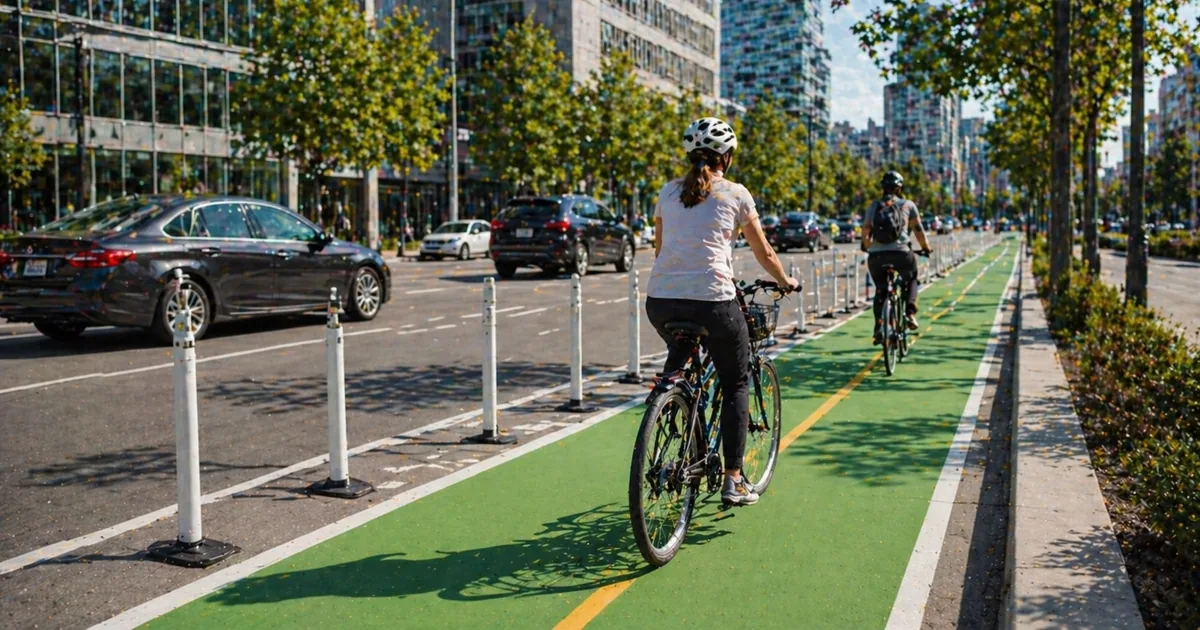
- Buffered, protected, and parking-protected lanes change the analysis. Where the lane is physically separated, several states either lift the must-use rule or treat the facility as an alternative path that the rider may choose.
- A sharrow is not a bike lane. Sharrow markings are signage indicating a shared travel lane; cyclists keep full lane rights and no must-use rule attaches.
- Most state vehicle codes let you leave the lane to avoid hazards. A blocked bike lane - delivery van, parked car, debris, snow piles - is a textbook statutory exception in every must-use state we reviewed.
The article body below walks through the five clearly drafted mandatory-use states - California, New York, Oregon, Hawaii, and Alabama - and then covers the FRAP-only states where the same practical effect comes from the general "as far right as practicable" rule. A consolidated state-by-state table is in progress as we finish verifying every state's code section; until then, treat the per-state breakdowns and your state's own laws page as the controlling reference.
Mandatory-use states
Five states stand out as having clearly drafted mandatory bike-lane statutes. The text varies but the structure is consistent: a general duty to use the bike lane when one is provided adjacent to the roadway, followed by a defined list of exceptions. These are the states a touring cyclist should pay closest attention to.
California - Cal. Veh. Code § 21208
California's § 21208(a) requires any cyclist riding slower than "the normal speed of traffic" to use a designated Class II bike lane where one exists 5. The five statutory exceptions are: (1) overtaking and passing another cyclist, vehicle, or pedestrian; (2) preparing for a left turn at an intersection or into a private road or driveway; (3) avoiding hazards including parked or moving vehicles, pedestrians, animals, surface hazards, or substandard-width lanes; (4) approaching a place where a right turn is authorised; and (5) the bike lane being unsafe for any reason. The Caltrans Highway Design Manual sets the design width for a Class II bike lane and is the engineering reference behind the "substandard width" exception 6.
New York - V&T § 1234(a)
New York's V&T § 1234(a) requires cyclists to use a "usable bicycle lane" when one is provided, except when preparing for a left turn, when overtaking, when avoiding unsafe conditions including but not limited to fixed or moving objects, parked or moving vehicles, pedestrians, animals, surface hazards, or traffic lanes too narrow for a bicycle and a vehicle to travel safely side by side 7. The phrase "usable" is doing a lot of work in the statute: a lane blocked by a delivery van, packed with snow, or strewn with broken glass is not legally "usable", and the cyclist is free to leave it. New York City Department of Transportation guidance on protected and buffered lanes complements the statute but does not displace it 8.
Oregon - ORS 814.420
Oregon's ORS 814.420 is the strictest mandatory-use statute on this list, requiring riders to use a bicycle lane or path adjacent to the roadway whenever one is provided 9. The statutory exceptions are similar to California's - overtaking, preparing for a left turn, avoiding debris or other hazardous conditions, continuing straight where the bike lane turns to the right - and the Oregon Department of Transportation publishes companion guidance describing when the exceptions apply 10. Oregon courts have repeatedly tested the statute's exceptions, and the practical takeaway from that case law is that the "hazardous conditions" carve-out is meaningful - it is not limited to debris in the lane.
Hawaii - HRS § 291C-145
Hawaii's HRS § 291C-145 requires cyclists to ride in a designated bicycle lane when one is provided, with exceptions for overtaking, preparing for a left turn, and avoiding debris or other hazards 11. The statutory text is shorter than California's or Oregon's but the structure is identical.
Alabama - § 32-5A-263
Alabama's § 32-5A-263 requires cyclists to ride in a designated bike lane where one is provided, again with the standard set of exceptions 12. Alabama's statute is notable because it is one of the few in the South with explicit bike-lane language - most southern states rely on the general FRAP rule discussed below.
Statutory exceptions to must-use
The exceptions are where the must-use rule lives or dies. Across the five states with explicit bike-lane statutes, the same list of carve-outs appears in slightly different words. A defensible "I left the lane because…" claim almost always falls into one of the categories below.
- Substandard lane width. Where the bike lane is narrower than the engineering minimum (typically 4 feet adjacent to a curb, 5 feet adjacent to parked cars under FHWA and AASHTO guidance) 3, the rider may take the general travel lane.
- Hazards in the lane. Glass, gravel, potholes, drainage grates with bike-unfriendly slot orientation, ice, standing water, and snow piles are all paradigm cases. State statutes typically use the catch-all phrase "surface hazards."
- Parked vehicles and the door zone. Where a bike lane is striped immediately adjacent to parallel parking, the door-zone strip - typically the rightmost two to three feet of the lane - is a recognised hazard. Most statutes do not require riders to use the door-zone portion of the lane.
- Moving obstructions. A delivery van stopped in the bike lane, a turning vehicle blocking the lane, a pedestrian crossing through the lane, or a slower cyclist ahead all qualify.
- Preparing for a left turn. Every must-use statute carves out the merge across general travel lanes that is necessary to set up a left turn at an intersection or driveway.
- Overtaking another cyclist. A bike lane wide enough to ride in is rarely wide enough to safely pass another cyclist; the overtaking exception is universal.
- Lane terminates or turns the wrong way. Where the bike lane ends, drops, or veers to the right at an intersection where the cyclist intends to continue straight, the rider may merge into the general travel lane in advance of the termination point.
- Right-turn approaches. Some statutes (California's § 21208 explicitly) carve out the case where a cyclist is approaching a place where a right turn is authorised - that is, when the bike lane is to the left of a right-turn-only lane and the cyclist is going straight.
These exceptions are not technicalities. They are the legislature's recognition that bike lanes are a piece of infrastructure that does not work in every situation, and that requiring use of a lane that has been blocked, narrowed, or made unsafe would defeat the rule's purpose.
The "as practicable" alternative
States without an explicit bike-lane statute almost always have a general "ride as far to the right as practicable" (FRAP) rule that operates as the de facto mandatory-use rule whenever a road happens to have a bike lane. Florida's Fla. Stat. § 316.2065(5)(a) 13 is the classic example: a cyclist proceeding at less than the normal speed of traffic must ride in the lane marked for bicycle use or, if no such lane exists, as close as practicable to the right-hand curb or edge of the roadway, with exceptions for left turns, overtaking, avoiding hazards, and substandard-width lanes.
The FRAP rule is materially different from a bike-lane statute on at least three points. First, the exceptions are usually broader and more open-textured - "as practicable" is a flexible standard that has produced a body of case law more favourable to riders than a strict mandatory-use rule. Second, FRAP rules generally apply only when the cyclist is moving slower than the normal speed of traffic; on a downhill or in slow congested traffic where the cyclist matches vehicle speed, the duty arguably does not apply. Third, FRAP rules do not impose any duty specific to a bike-lane facility - a poorly designed, hazardous, or unmaintained bike lane can be ignored without engaging the lane-specific exception language.
In day-to-day riding the practical effect of FRAP and a bike-lane statute is hard to distinguish, which is why many guides conflate the two. Legally, however, knowing whether you are in a bike-lane state or a FRAP-only state matters when a citation is contested or a crash claim is litigated.
Buffered, protected, and parking-protected lanes
The legal status of a bike lane shifts when the lane has physical separation. The FHWA's Bikeway Selection Guide and the NACTO Urban Bikeway Design Guide both treat protected and buffered lanes as a meaningfully different facility from a conventional painted bike lane 12. The 2012 AASHTO Guide for the Development of Bicycle Facilities sets the engineering baselines that most states reference 3.
A few patterns are worth knowing:
- Buffered lanes - a conventional painted bike lane with an extra striped buffer separating it from general traffic - are generally treated as bike lanes for must-use purposes. The buffer does not change the legal classification, only the design.
- Protected lanes - sometimes called "cycle tracks" - use vertical separation (curb, planter, flexposts, parked cars) to physically separate cyclists from motor traffic. Several states do not extend their bike-lane mandatory-use statute to protected lanes because the lane is no longer "adjacent to the roadway" in the statutory sense. New York's NYC DOT explicitly designates many protected lanes as a separate facility class 8.
- Parking-protected lanes - where parallel parking sits between the cyclist and the moving traffic lane - are a particular hazard from the dooring perspective on the passenger side, where doors open into the bike lane. Statutory hazard-avoidance exceptions usually allow a rider to leave the lane to avoid that risk.
- Two-way protected lanes on one-way streets require attention to direction-of-travel rules; some jurisdictions treat the contraflow direction as a separate legal facility with its own signal phase.
If you ride regularly in a city with a growing protected-lane network, it is worth reading the state statute and the city DOT's own classification guide to understand which mandatory-use rule, if any, applies to each facility on your route.
Bus lanes and shared bike-bus lanes
Bus lanes are a perennial question. The general rule is that bus lanes are restricted to buses and other authorised vehicles unless explicitly opened to bicycles by signage. Where the lane is signed as a shared bike-bus lane - common in San Francisco, Seattle, New York, and many European cities - cyclists are an authorised user. Where the lane is bus-only, riding in it is typically a violation of the local traffic code. None of the must-use bike-lane statutes treat a bus lane as a substitute for a designated bike lane.
When riding a shared bike-bus lane, the practical etiquette is to position yourself so a bus can pass safely at a bus stop, to avoid the door-zone of stopped buses, and to be aware that bus drivers are typically the most professional and predictable drivers on the road. The legal duty is the same as in any other lane: yield to pedestrians, signal turns, and obey the traffic-control devices.
Sharrows are not bike lanes
A shared-lane marking - the chevron-and-bicycle symbol painted in the centre of a travel lane, commonly called a "sharrow" - is signage, not a designated bike lane. The FHWA Manual on Uniform Traffic Control Devices (MUTCD) treats sharrows as guidance markings indicating a preferred lateral position for cyclists in a shared lane, not as a separately designated cycling facility 4.
Two consequences follow. First, no must-use rule attaches to a sharrowed lane. The cyclist has full general-travel-lane rights and may take the lane where conditions warrant. Second, the FRAP rule still applies in the abstract, but it is significantly limited by the sharrow's purpose: the marking signals to drivers that cyclists are expected to occupy that part of the lane, which is itself evidence that occupying it is "practicable." A motorist citation for honking or aggressive passing in a sharrowed lane is a more straightforward enforcement case than the same conduct on an unmarked street.
Contraflow lanes
Contraflow bike lanes - bike lanes that allow cyclists to travel against the direction of motor-vehicle traffic on a one-way street - exist in a handful of US cities, including Boston, Cambridge, Washington DC, Portland, and Minneapolis. Where a contraflow lane is striped and signed, riding against traffic in that lane is legal; in the same direction the rest of the street operates as a one-way road for motor vehicles, the cyclist is on a two-way bicycle facility.
The legal subtlety is that outside the marked contraflow lane, the one-way rule applies to cyclists too. State vehicle codes uniformly require cyclists to ride in the same direction as traffic on a one-way street unless a designated facility provides otherwise. Treating a one-way street as informally bidirectional because there is room to do so is a citation waiting to happen and, more importantly, a statistically poor safety choice - wrong-way riding is a leading factor in cyclist-vehicle crashes at intersections.
What to do when a bike lane is blocked
A blocked bike lane - delivery van, ride-share pickup, double-parked car, construction zone, snow pile, garbage bins on collection day - is the single most common real-world reason cyclists need to leave the lane. Every must-use statute we reviewed includes a hazard-avoidance exception that covers exactly this situation, and FRAP states reach the same result through the more general "as practicable" language.
The practical sequence:
- Look back and signal early. Merging across a general travel lane is a vehicle movement and triggers the standard duty to signal and to yield to traffic already in the lane.
- Take the full lane to the left of the obstruction. Sharing the lane with passing motor vehicles in the merge area increases dooring and side-swipe risk; controlling the lane is safer than hugging the obstruction.
- Return to the bike lane once it is clear. The exception only applies for the duration of the hazard; lingering in the general travel lane after the hazard is past is a different question.
- Document recurring blockages. In most US cities, blocking a bike lane is itself an enforcement violation for the offending driver. Photographing and reporting persistent offenders - through 311, a bike-lane-blocking app, or a complaint to the local DOT - is the long-term mechanism for getting the lane back.
Single-file rules in bike lanes
Whether cyclists must ride single-file inside a bike lane is governed by the general two-abreast statute in each state, not by the bike-lane statute itself. Most states allow two-abreast riding so long as the cyclists do not impede normal traffic flow; some prohibit two-abreast riding outright; a small number explicitly limit two-abreast riding to bike lanes wide enough to accommodate it. A bike lane that is narrower than the combined width of two riding cyclists effectively forces single file regardless of the underlying statute.
Related guides
Related guide
Browse the full Bike-Laws Hub
Helmet rules, sidewalk laws, lighting requirements, hand signals, DUI on a bike, and more - every topic with primary-source citations.
Related guide
Read the full California bicycle laws guide
California is the most-cited mandatory bike-lane state - see how § 21208 fits with the rest of the Vehicle Code's bicycle provisions.